Published
A plot looks perfect on the site visit, and the seller says it is “approved.” Approved by whom, and can you check it yourself? DTCP approved plots lie outside Chennai’s metropolitan area, while CMDA approved plots lie inside it, and each approval has a different office and a different paper trail.
Let’s learn how to tell which authority applies to your plot, how to verify the approval step by step, which documents to ask for, and what your options are if the layout is unapproved. It is general information, so have an advocate review the title and approvals before you pay.
Key takeaways
- CMDA approves layouts inside the Chennai Metropolitan Area; DTCP approves layouts in the rest of Tamil Nadu.
- Verify DTCP approved plots by the approval number itself, and match its survey numbers to the sale deed.
- Approval is not proof of title: check the patta and the encumbrance certificate separately.
- Regularisation covers only plots sold by registered deed on or before 20 October 2016.
What are DTCP approved plots, and what does CMDA approve?
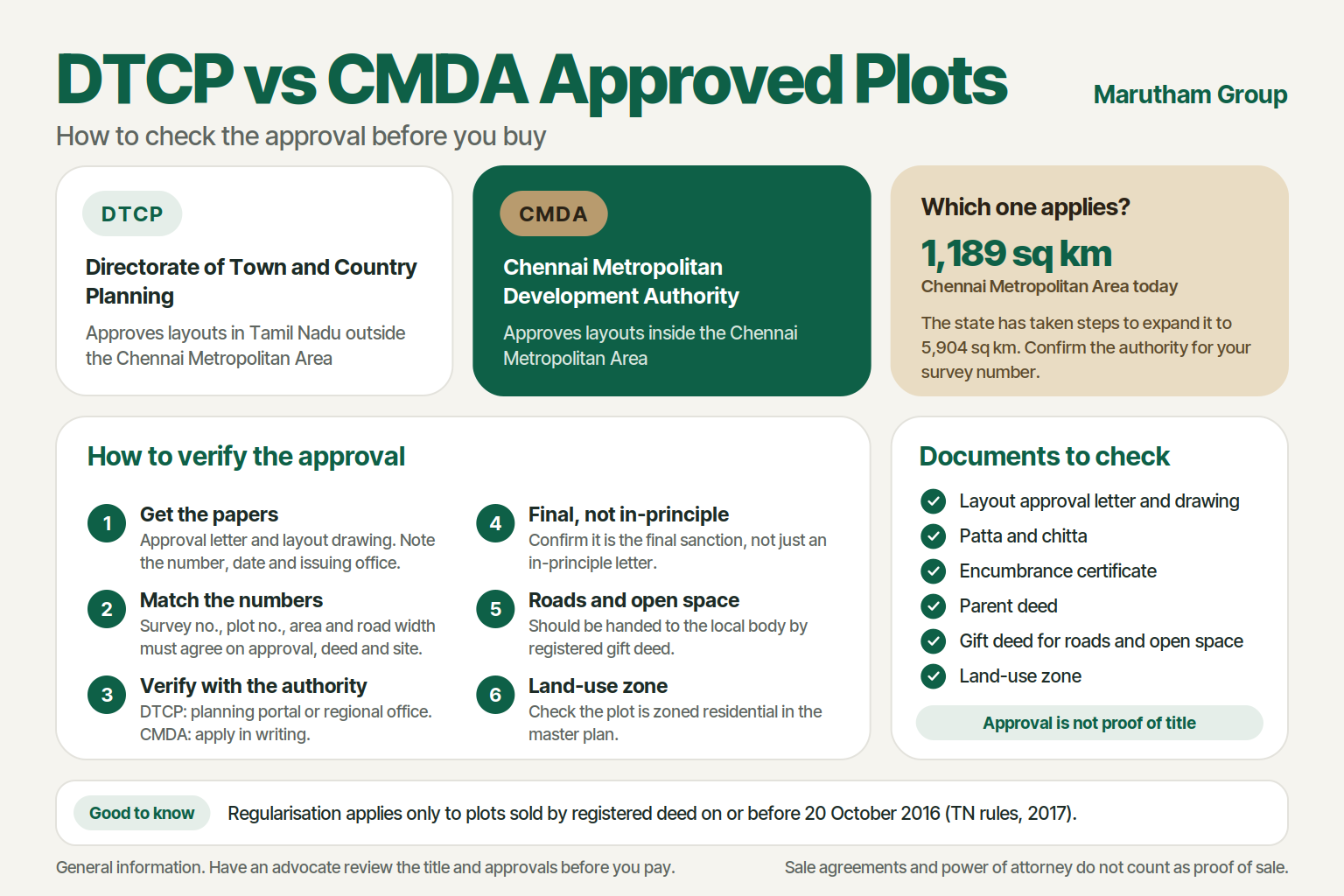
DTCP approved plots are plots in a layout sanctioned by the Directorate of Town and Country Planning, the state body that approves layouts outside the Chennai Metropolitan Area. CMDA approved plots sit in layouts approved by the Chennai Metropolitan Development Authority inside that area. Both approvals confirm the layout plan, not who owns the land.
| DTCP approved plots | CMDA approved plots | |
|---|---|---|
| Approving body | Directorate of Town and Country Planning | Chennai Metropolitan Development Authority |
| Where it applies | Tamil Nadu outside the Chennai Metropolitan Area | Inside the Chennai Metropolitan Area |
| What you ask the seller for | Approval letter, layout drawing and approval number | Approval letter, layout drawing and approval number |
| What it does not prove | Clear title or a registered road handover | Clear title or a registered road handover |
Which approval applies to your plot?
The Chennai Metropolitan Area is about 1,189 sq km today. The state has taken steps to expand it to 5,904 sq km, as DT Next reported in October 2026, adding parts of Chengalpattu, Kancheepuram, Tiruvallur and Ranipet districts. That makes the boundary a live question for plots on Chennai’s edges.
How do you check DTCP approved plots?
To check if a plot is DTCP approved, get the approval letter and layout drawing from the seller, then verify the approval number with the authority. Match the survey number, plot number, area and road width on the drawing to your sale deed and to the land itself. Treat a plot as approved only after the authority confirms the record.
- Ask for the approval letter and the layout drawing. Note the approval number, the date and the issuing office.
- Match the numbers. The survey numbers, plot number, area and road width should agree across the approval, the sale deed and the site.
- Verify the record with the authority. Tamil Nadu’s online planning permission portal is where DTCP applications are handled. Guides report that you can search it with the approval number, but the portal pages we could read described building plan steps only, so confirm the search with the DTCP regional office.
- Check that the layout is final. Ask whether the approval is the final sanction by the local body, not just an in-principle letter.
- Check the roads and open space. The Directorate of Town and Country Planning’s own buyer checklist says internal roads and park areas should be handed to the local body by gift deed.
- Look at the land-use zone. The same checklist asks buyers to check the plot’s zone in the master plan.
How do you check CMDA approved plots?
For CMDA approved plots, ask the seller for the CMDA approval letter and layout sketch, then confirm both with CMDA directly. We found no public search tool for layouts that we could verify, so apply to CMDA in writing with the approval reference. Check that the approval is final, not only in-principle.
Which documents should you verify before buying a plot in Tamil Nadu?
Before buying a plot in Tamil Nadu, verify the layout approval letter and drawing, the patta and chitta, the encumbrance certificate, the parent deed, the road and open-space gift deed, and the land-use zone. Approval and title are separate checks, so each document answers a different question, whether the plots are DTCP approved plots or CMDA approved plots.
| Document | What it tells you | What to check |
|---|---|---|
| Layout approval letter and drawing | Which authority approved the layout | Number, date, survey numbers, final or in-principle |
| Patta and chitta | Who holds the land records | Seller’s name, survey number, extent |
| Encumbrance certificate | Loans or transfers on record | Period covered, any charge on the plot |
| Parent deed | How the seller got the land | Chain of ownership, matching survey numbers |
| Gift deed for roads and open space | Whether roads belong to the local body | Registered, with matching extent |
| Land-use zone | What the master plan allows | Residential zoning for your plot |
What if the plot is unapproved?
An unapproved plot can be regularised only if it was sold by a registered deed on or before 20 October 2016. That is the cut-off in the Tamil Nadu regularisation rules, 2017. A sale agreement or power of attorney does not count as proof of sale under those rules.
Do not assume you can regularise a plot you purchase today. Some land is excluded outright, including water bodies, government land, reserved open space, land in proposed road alignments and land under high-tension lines.
What is the plot registration process in Tamil Nadu?
The plot registration process in Tamil Nadu starts after the checks, not before. Verify the documents, pay stamp duty and the registration fee, then both parties sign the sale deed at the sub-registrar’s office. The registered deed is then collected or downloaded.
- Verify the approval and the title documents.
- Check the guideline value, since duty is charged on the higher of guideline value and sale value.
- Pay stamp duty and registration
- Both parties attend the sub-registrar’s office with originals and ID.
- Photographs, thumb impressions and signatures are recorded.
- Collect the registered deed.
Register within four months of signing the sale deed.
Conclusion: check the approval, then the title, then register
DTCP approved plots and CMDA approved plots are not interchangeable labels: first find which authority covers the plot, then verify the approval number, then check the title documents. Regularisation is a narrow route that depends on a 2016 cut-off, so do not count on it.
If you are comparing plots in Redhills, see the approval details on the Marutham Royal Park plots page and ask for the approval letter and layout drawing before your site visit. This article is general information; confirm legal points with a qualified advocate.
Frequently asked questions
How do I check if a plot is DTCP approved?
Ask the seller for the approval letter and layout drawing, note the approval number, and match the survey numbers to your sale deed. Then confirm the record with the authority, using the state planning portal or the DTCP regional office. Check that the approval is final and that the roads were handed to the local body.
Which documents should I verify before buying a plot in Tamil Nadu?
Verify the layout approval letter and drawing, the patta and chitta, the encumbrance certificate, the parent deed, the gift deed for roads and open space, and the land-use zone. Have an advocate check the title and the approvals together before you pay any advance.
What is the difference between DTCP and CMDA approval?
CMDA approves layouts inside the Chennai Metropolitan Area, about 1,189 sq km today, and the Directorate of Town and Country Planning approves layouts elsewhere in Tamil Nadu. The boundary may widen if the planned expansion to 5,904 sq km goes through, so confirm the authority for your survey number.
Can I buy an unapproved plot and regularise it later?
Not reliably. The 2017 rules cover only plots sold by registered deed on or before 20 October 2016, and some land is excluded altogether. A plot you purchase now may fall outside that route, so confirm eligibility with the authority and an advocate before you buy.
Is DTCP approval proof that the title is clear?
No. Approval confirms the layout plan, not ownership. Check the patta, the encumbrance certificate and the parent deed separately, and have an advocate review the chain of title. The Directorate of Town and Country Planning’s own checklist lists ownership checks as a separate step from layout approval.
Can I get a home loan for a DTCP approved plot?
Banks set their own rules, so ask your lender before you book. Lenders usually ask for the approved layout and clear title papers, so keep the approval letter, patta and encumbrance certificate ready. Do not pay a large advance until your bank confirms which documents it needs.
What is the plot registration process in Tamil Nadu?
Verify the approval and title, pay stamp duty and the registration fee through TNREGINET or authorised banks, then both parties sign the sale deed at the sub-registrar’s office. Photographs and thumb impressions are recorded, and the registered deed is then collected or downloaded.